Why Concrete Costs More in the Bay Area — and Why Two Bids Never Match
National cost guides quote one number; Bay Area quotes come in higher and all over the map. Here’s what actually drives concrete pricing here — hills, access, soil, permits — and how to compare bids that don’t match.
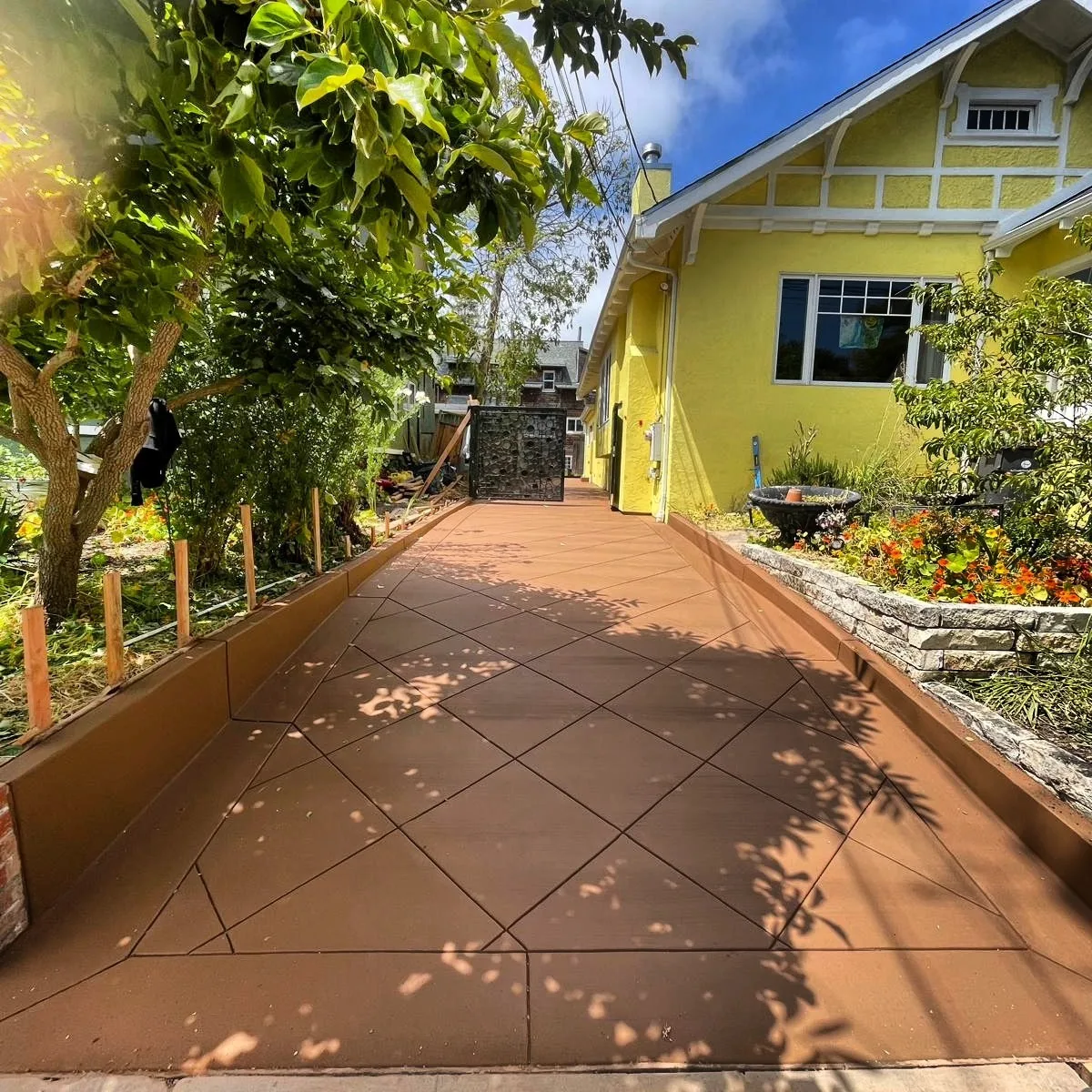
Search “concrete driveway cost” and you’ll find tidy national numbers — the concrete industry’s own Concrete Network pegs a plain gray driveway at $5–$8 per square foot, with decorative finishes running $8–$21. Then you collect three bids in Berkeley or Oakland and none of them look like the guides — and they don’t look like each other, either. Both things have the same explanation: in the Bay Area, the site drives the price more than the concrete does.
We don’t publish a price list, and this post won’t give you one — a real number requires walking your property, and any contractor quoting off square footage alone is guessing. What we can do is show you exactly where Bay Area bids come from, so the quotes you collect start making sense.
Access: the line item flatland cost guides skip
A concrete truck weighs around 30 tons loaded and needs somewhere to stand. On a flat suburban lot in Pleasanton, it parks in the street and chutes straight into the forms — cheap. On a narrow street in the Berkeley hills, or a backyard ADU pad in Richmond with a 3-foot side gate, the concrete has to be pumped, and a boom or trailer pump adds real money to every pour day. Steep or tight sites can also mean smaller equipment, more hand digging, and more labor hours for the same yardage. Two identical slabs can price thousands apart on access alone.
The ground under it: East Bay soil is not free
Much of the East Bay flats sit on expansive clay — soil that swells when winter rains come and shrinks hard in the dry season. Engineers respond with deeper footings, more rebar, thicker slabs, or moisture barriers, and each of those shows up in your bid. On hillsides, the answer is often drilled piers down to stable material before any visible concrete happens — the same engineering that drives foundation and retaining wall pricing. If one bid includes what the soils report calls for and another ignores it, the cheaper bid isn’t cheaper — it’s incomplete.
Demo, haul-off, and dump fees
Most Bay Area driveway and patio jobs start by breaking out old concrete, and disposal here is expensive — Bay Area landfill and transfer-station fees are among the highest in the country, and a driveway’s worth of rubble is several truckloads. Bids that “forget” haul-off look attractive until the change order arrives. Ask every bidder: is demolition, hauling, and dump included?
Permits and inspections vary city by city
A sidewalk or curb cut in Berkeley involves the city’s public works counter; Oakland has its own permit process; San Francisco routes through DBI and often Public Works for anything touching the right-of-way. Foundations and structural work are inspected work everywhere — pre-pour inspections are part of the schedule, not optional. Permit costs and the labor of managing them differ by city, and legitimate bids carry those costs. We’ve mapped the actual rules — what needs a permit and what doesn’t, city by city — in our East Bay concrete permit guide.
Why two bids for the same job come back so different
When bids for the same project land far apart, the difference is almost always scope, not greed or generosity. Line the bids up and check what each one actually says about:
- Base prep — how many inches of compacted base rock, or none specified at all
- Reinforcement — engineered rebar on chairs vs. wire mesh vs. nothing
- Thickness — a 4-inch slab and a 5.5-inch driveway apron are very different pours
- Drainage — slope, drains, and where roof and surface water will actually go
- Demo and haul-off — included, excluded, or vague
- Finish — plain gray broom finish vs. color, score patterns, or exposed aggregate
- Licensing and insurance — an unlicensed crew with no workers’ comp is cheaper right up until something goes wrong
Every California contractor’s license can be checked in about a minute at cslb.ca.gov — ours is #1020281, in the footer of every page on this site. If a bid is dramatically lower, the checklist above will almost always show you what was left out. (Planning a driveway specifically? Our concrete driveway page walks through what a complete scope includes, line by line.) And if you want a real number for your project instead of a range from a national guide: we walk Bay Area sites and give free, itemized estimates. That visit is exactly how the guesswork comes out of the price. Want a rough starting range for a straightforward slab in the meantime? Our slab cost calculator is built on the same published industry figures, adjusted for the Bay Area.
Common questions
Why are concrete quotes higher in the Bay Area than the national averages?
Labor and disposal cost more here, and far more Bay Area jobs involve slopes, tight access, pump trucks, expansive soil, or engineered reinforcement than the national “average” job assumes. Industry guides like Concrete Network are useful for ballparks, but they describe a flat lot with easy truck access.
Is the cheapest concrete bid ever the right choice?
Sometimes — if its scope genuinely matches the others. Compare base prep, rebar, thickness, demo/haul-off, and drainage line by line. A low bid that skips base rock or reinforcement costs more when the slab cracks in two winters.
Do I need a permit for a new driveway or sidewalk?
Often yes, especially where the work touches the sidewalk, curb, or right-of-way — rules differ by city (Berkeley, Oakland, San Francisco, and Richmond each run their own process). Foundations and retaining walls over standard heights are permitted and inspected work everywhere. A legitimate bid accounts for this — our city-by-city permit guide covers exactly what needs one where.
Why won’t contractors publish a price list?
Because the site sets the price. Access for the truck, slope, soil condition, demo, and finish can move an identical-sized job by thousands of dollars. A published per-square-foot rate would be wrong for most Bay Area properties — that’s why we quote after walking the site, for free.
Sources & further reading
Planning a concrete project?
We offer free estimates across the San Francisco Bay Area. Tell us what you’re working on and we’ll walk the site with you.
Request an estimate